
Doors are an essential element of every building — residential, commercial, or public. Although we encounter them daily, choosing the right type for a project can be more complex than it first appears.
Depending on the required function — entrance, internal, balcony, or sliding — developers and architects can select from a variety of materials: timber, aluminium, steel, or PVC. Each option has its advantages and limitations:
Timber requires regular maintenance and is prone to warping.
Aluminium can have lower thermal insulation in certain configurations.
Steel (armored) is ideal for exterior security doors but less suitable for interior use.
PVC has become the preferred choice across multiple categories due to its performance, affordability, and low maintenance.
Why Choose PVC Doors for Your Project
PVC doors are widely appreciated in both new-build and renovation projects for their stability, thermal efficiency, and cost-effectiveness. In addition to these benefits, AVEPLAST PVC door systems deliver high security, airtightness, and design flexibility.
One of the biggest advantages of PVC doors is their easy maintenance — they do not require repainting or refinishing and are simple to clean. Combining functionality with modern design, AVEPLAST offers four main types of PVC doors, each designed for different applications.
1. Exterior (Entrance) Doors
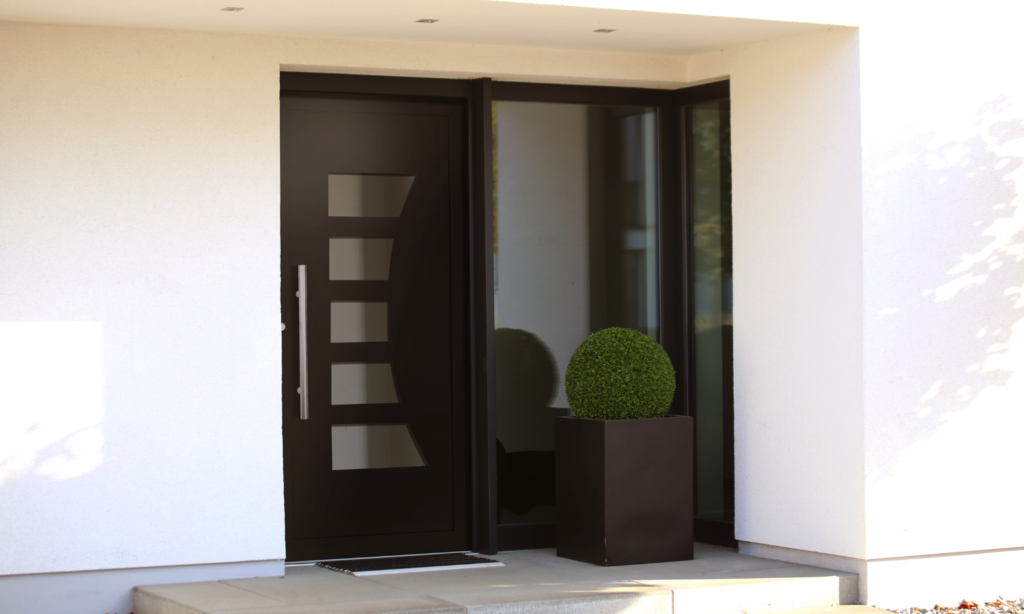
PVC entrance doors represent the architectural signature of a building façade.
They can be customized in terms of shape, color, glazing, and security class, combining durability with a welcoming aesthetic.
High insulation values and reinforced hardware ensure that AVEPLAST exterior doors provide excellent protection against both weather and unauthorized entry, meeting European standards for energy and security performance.
Key benefits:
Multiple design and color options
Excellent thermal and acoustic insulation
Enhanced anti-burglary protection
Long service life and weather resistance
2. Interior Doors
Designed for durability and functionality, PVC interior doors are ideal for modern residential and commercial interiors. Reinforced hinges and locking systems guarantee stability even under intensive use.
Due to their design flexibility, these doors can be seamlessly integrated into both minimalist and traditional interiors. They are especially suited for multi-apartment buildings, offices, and institutional spaces where reliability and uniform design are priorities.
Key benefits:
Long-lasting performance
Minimal maintenance
Sound insulation and smooth operation
Wide aesthetic and design flexibility
3. Sliding Doors (Portal Systems)
Sliding door systems — often referred to as HS or PSK portals — have become increasingly popular in modern residential and hospitality projects. They combine wide glazing areas, thermal efficiency, and operational comfort, creating a seamless connection between indoor and outdoor spaces.
Large glass panels bring abundant natural light, enhancing the feeling of openness and expanding the visual space. AVEPLAST sliding systems are available in various configurations, including manual and motorized options, and are fully compatible with energy-efficient glazing packages.
Key benefits:
Superior thermal insulation and airtightness
Large, unobstructed glass surfaces
Smooth, reliable operation
Optional automation and safety features
4. Balcony Doors
Balcony doors combine functionality, durability, and comfort.
Their lighter construction and low threshold design ensure effortless access to terraces or outdoor areas — a practical solution for residential buildings and apartments.
Despite their lightweight form, AVEPLAST balcony doors maintain excellent tightness and thermal insulation, contributing to the building’s overall energy efficiency.
Key benefits:
Comfortable access with low threshold design
Compact and functional structure
High durability under frequent use
Consistent insulation performance